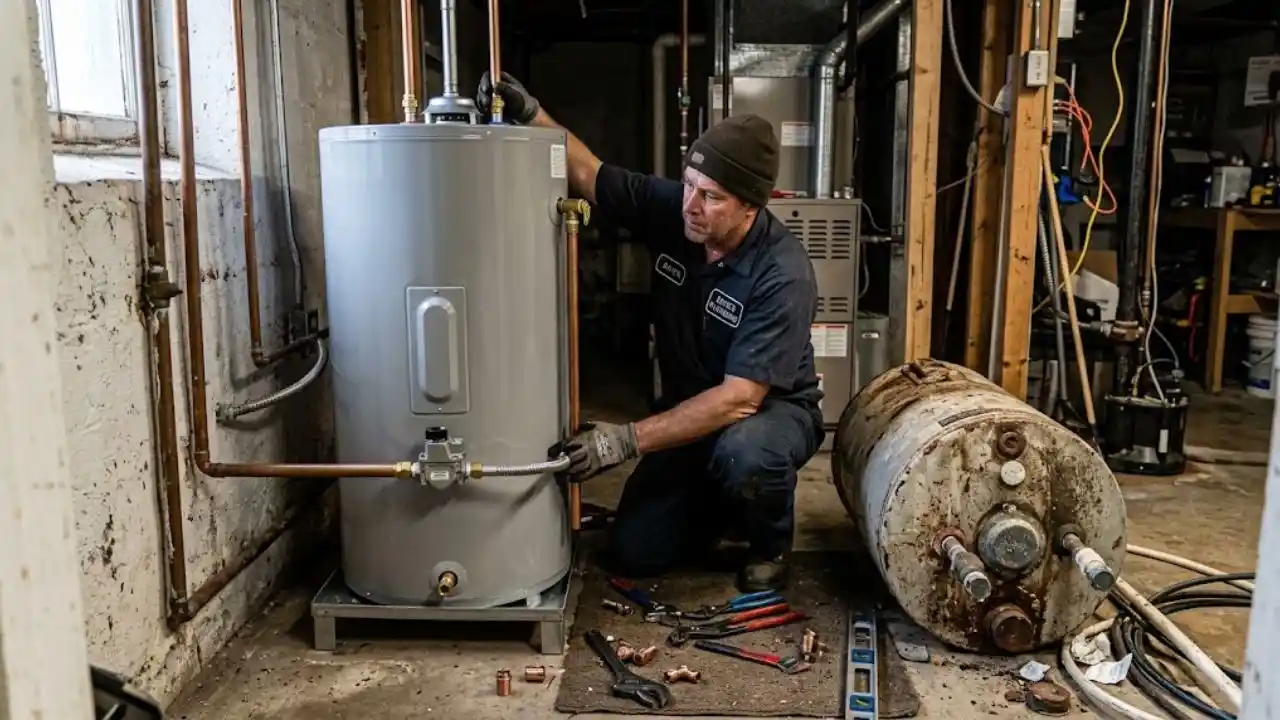
Water heater replacement cost is one of the most common questions we get, but the more useful question underneath it is usually repair versus replace. Here's a straightforward decision framework, followed by a real cost breakdown for whichever path you land on.
Step 1: How Old Is The Unit?
- Under 6 years old: repair almost always makes sense, regardless of what's wrong, unless the tank itself is physically leaking
- 6 to 10 years old: repair a single component failure (thermostat, heating element, thermocouple). Start weighing replacement if you're facing a second repair within 12 months
- 10 to 12 years old: this is the honest gray zone. A simple, cheap fix (like a thermostat) still makes sense. Anything involving the tank itself, or a repair quoted near half the cost of a new unit, tips toward replacement
- Over 12 years old: replacement is usually the better financial decision even for a repairable issue, since you're extending the life of a unit that's statistically close to failing outright, and repeated small repairs add up faster than one replacement
Step 2: Is The Tank Itself Leaking?
This one overrides the age question. Water pooling at the base of the tank almost always means the tank lining has failed, which is not a repairable component on a standard tank unit. If you see this, plan for replacement regardless of the unit's age.
Step 3: How Many Repairs Has It Needed Recently?
A unit that's needed more than one or two repairs in the past year is usually cheaper to replace than to keep patching, even if it's technically under 10 years old. Repeated failures on the same unit are often a sign of broader wear rather than isolated bad luck.
If You're Replacing: Tank Vs. Tankless, With Real Numbers
- Traditional tank: generally $1,400 to $3,800 installed for most York homes, 10-15 year typical lifespan, simpler installation in most existing setups
- Tankless: higher upfront cost than tank, but continuous hot water on demand, lower ongoing energy cost, and typically 20+ years of lifespan with a compact footprint. Often the better long-term value if you're planning to stay in the home for a decade or more
What Actually Moves The Price Within Those Ranges
- Tank capacity: a larger household needs a higher gallon-rated tank, which costs more
- Venting requirements: older York homes sometimes need updated venting to accommodate a new unit, particularly when switching fuel type or unit style, and this is one of the most common reasons a quote comes in above the base equipment price
- Access and removal: a unit in a tight utility closet takes longer to remove and install than one in an open basement
What's Included In A Proper Replacement Quote
Haul-away of the old unit should be standard, not an add-on. A proper quote comes after an inspection of your specific setup, not a rough number over the phone, since venting and access are exactly the kind of site-specific factors that change the final price. Most replacements are completed same-day for calls scheduled before early afternoon.
The Bottom Line
Run through the three-step framework above before calling anyone. If you land clearly on "repair," ask for a straight comparison of the repair cost against a new unit anyway, since a good plumber will tell you honestly if you're getting close to the point where replacement is the smarter money.
If this sounds like what you're dealing with, our water heater replacement and water heater repair pages go into more detail, and we serve Red Lion, PA along with the rest of York County on the same call-only basis described here.