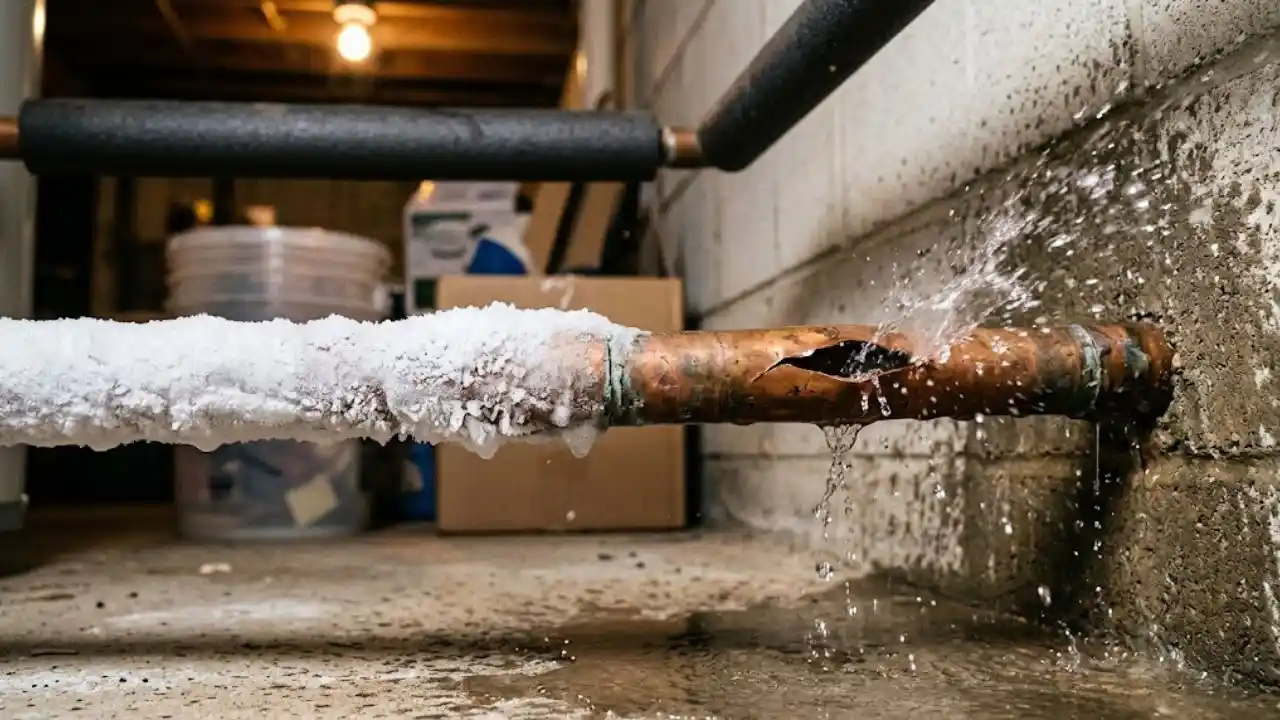
Frozen and burst pipes are related but need completely different responses, and mixing them up wastes time you don't have. Here's how to tell which one you're facing in under two minutes, and the exact steps for each.
The 2-Minute Diagnosis
- Go to the fixture that isn't working. Is there any water at all, even a trickle, or is it completely dry?
- Completely dry, no water at all: likely frozen, not burst. Go to the Frozen Pipe steps below
- Water flowing but pressure dropped suddenly across the whole house: likely burst somewhere in the system. Go to the Burst Pipe steps below immediately
- Check for visible signs either way: frost on an exposed pipe or a slightly bulging section points to frozen. Any visible water, a wet spot on a wall or ceiling, or the sound of running water when nothing is on points to burst
- If you're not sure and there's no visible water anywhere, treat it as frozen for now, but check back every 15 to 20 minutes, since a frozen pipe can progress to a burst one as ice continues expanding
If It's Frozen: Step-By-Step
- Locate the frozen section if it's in an accessible area (exposed pipe in a basement, crawlspace, or under a sink)
- Apply gentle, gradual heat using a hair dryer on a low-to-medium setting, held a safe distance from the pipe, moving it back and forth rather than holding it in one spot
- Open the closest faucet slightly while you work, so melting ice has somewhere to go and you'll know the moment water starts flowing again
- Never use an open flame, a blowtorch, or any high-heat tool directly on the pipe, which can damage it or create a fire risk
- If the frozen section is hidden inside a wall or you can't safely reach it, stop trying to thaw it yourself and call for help, since a hidden freeze that bursts mid-thaw with no one there to catch it can cause significant damage
- Once flow is restored, check the rest of the house for other areas that might also be at risk, especially if this pipe froze due to a specific cause (uninsulated crawlspace section, exterior wall) that might affect nearby lines too
If It's Burst: Step-By-Step
- Shut off your main water valve immediately. This is the single most important action and takes priority over everything else, including taking photos
- Turn off electricity to any area where water is actively contacting outlets or fixtures, only if you can do so safely without entering standing water
- Once the water is off, take photos of the damage for insurance purposes
- Call for emergency repair right away. Every additional hour of standing or spreading water increases both the repair scope and the risk of secondary damage like mold
- If there's meaningful standing water or soaked flooring, plan for water mitigation (extraction and drying) as a separate but immediate next step, not something to handle later
When One Becomes The Other
A frozen pipe that isn't addressed can still burst as ice continues to expand inside it, which is why catching a freeze early, rather than waiting to see if it thaws on its own overnight, is worth the effort during a York cold snap. If you started with a frozen pipe and it progresses to active water flow or a sudden pressure drop while you're working on it, stop the thawing process immediately and switch directly to the burst pipe steps above, starting with the main water shutoff.
If this sounds like what you're dealing with, our frozen pipe repair and burst pipe repair pages go into more detail, and we serve Hallam, PA along with the rest of York County on the same call-only basis described here.