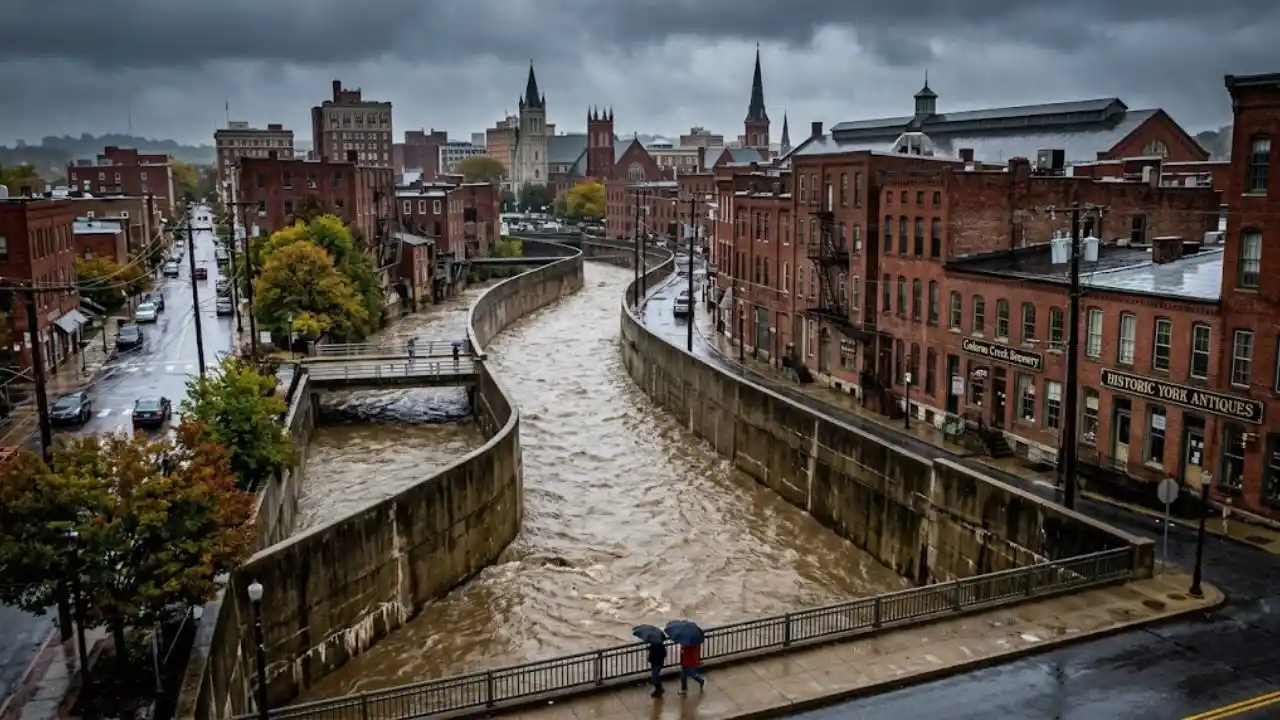
If you own a home near downtown York, you've probably heard some version of the Codorus Creek flood story. It's not exaggeration. The creek has a documented history of serious flooding, and understanding it changes how you should think about your specific basement, not just the neighborhood in general. This isn't a general awareness post. By the end, you should know how to check your own risk level and what to actually do about it.
The Two Events That Define The Risk
In August 1933, York experienced a storm that dropped roughly 13.5 inches of rain in 24 hours, a genuinely extreme rainfall total that overwhelmed the creek. Then in June 1972, the remnants of Hurricane Agnes pushed the creek's flow from a typical 220 cubic feet per second up to roughly 30,000 cubic feet per second. Both events are real, well documented, and still referenced in York's flood planning today.
What Changed After 1972
The Army Corps of Engineers had already built Indian Rock Dam, completed in 1942, and after the 1972 flood, additional levees and six stormwater pump stations were completed by 1980. Together, that flood control infrastructure significantly reduced the frequency and severity of major flooding for downtown and creek-adjacent York. That's the good news. The infrastructure genuinely works for what it was built to handle.
Step 1: Check Your Actual Flood Zone, Not Just Your Neighborhood
Reduced isn't eliminated, and "near the creek" isn't specific enough to make a real decision. FEMA maintains a flood map service that shows the actual designated flood zone for any address, not just a general sense of proximity. Search "FEMA flood map service center" and enter your address. A property in Zone AE or A is in a mapped high-risk flood area. Zone X means minimal flood risk from the mapped 100-year floodplain, which covers most of York outside the immediate creek corridor. This single lookup takes about two minutes and tells you more than any general history lesson can.
Step 2: Know What Your Homeowners Policy Actually Covers
A standard homeowners policy typically covers sudden water damage from a failed pipe or appliance. It does not typically cover flood water entering from outside, including creek overflow or heavy surface water runoff. If your address falls in a FEMA-mapped flood zone, a separate flood insurance policy through the National Flood Insurance Program is worth pricing out, even if it's not required by your mortgage lender. If you're in Zone X, this is a lower priority, though basement water entry from heavy rain and groundwater is still worth planning for separately from flood insurance.
Step 3: Assess Your Basement's Actual Vulnerability
- Check for water stains, efflorescence (white chalky residue), or a musty smell along your foundation walls, which indicate past water entry even without an active flood
- Locate your sump pump, if you have one, and test it by pouring a few gallons of water into the sump pit to confirm the float switch triggers
- Check whether your sump pump has a battery backup. A pump that only runs on AC power fails exactly when storm-related outages are most likely
- Note your basement's grade relative to the street and yard. Basements below street grade in older creek-adjacent construction carry more water pressure risk during heavy rain
- Check gutters and downspouts extend at least four to six feet from the foundation, since redirected roof water is a bigger contributor to basement dampness than most homeowners expect
What To Do If You're In A Higher-Risk Zone
If your address checks out as higher risk on the FEMA map, or your basement already shows signs of past water entry, the practical fix is an interior drainage system paired with a sump pump that has battery backup. That addresses the realistic version of this risk: heavy rain and groundwater pressure during a storm, especially one that also knocks out power. That's a different, more manageable problem than the historic creek-overflow events, and it's genuinely fixable. Our basement waterproofing page walks through what that installation actually involves and costs for a York home.
During An Active Flood Warning
- Move anything stored directly on the basement floor up onto shelving before water is an issue, not after
- Know where your home's main electrical panel is relative to potential water entry points, and never enter a flooded basement if there's any chance the panel or outlets are submerged or wet
- If your sump pump is running constantly during a storm and you don't have a battery backup, that's the moment a portable generator or backup battery earns its cost
- After water recedes, treat any flooding from the creek or surface water as contaminated until proven otherwise, and prioritize extraction and drying within 24 to 48 hours to limit mold risk
If this sounds like what you're dealing with, our basement waterproofing and sump pump installation & repair pages go into more detail, and we serve North York, PA along with the rest of York County on the same call-only basis described here.