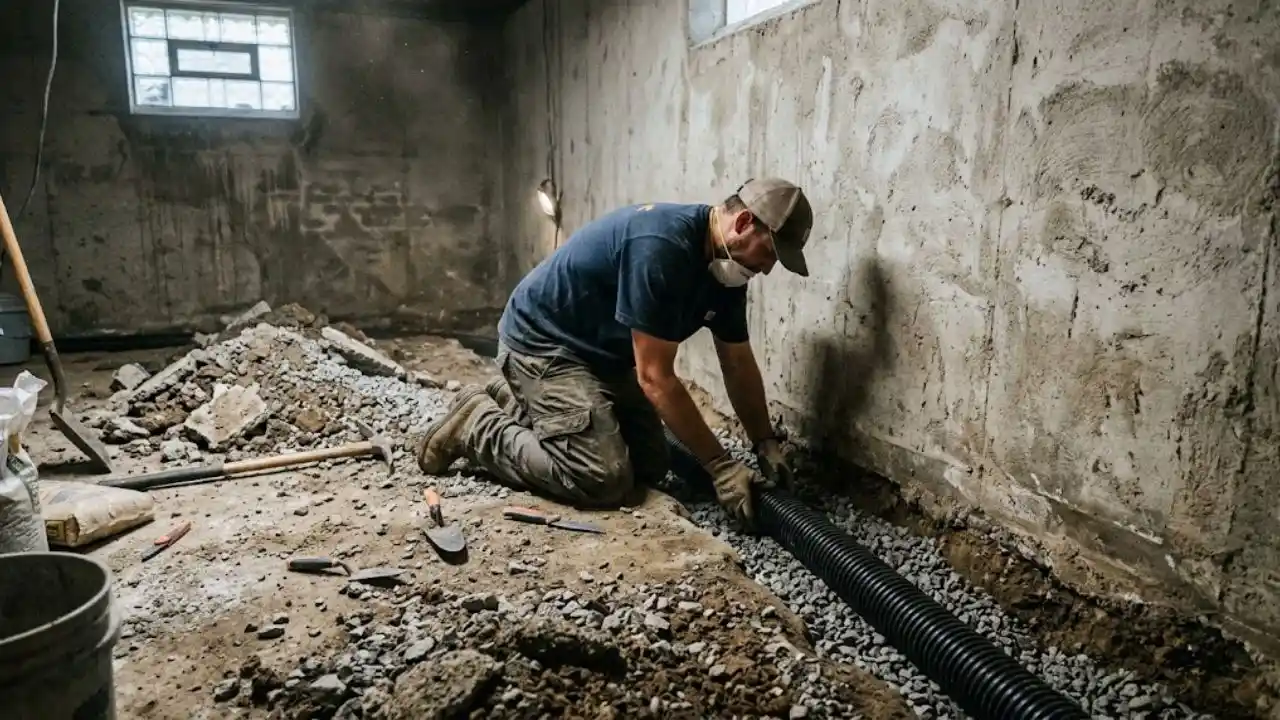
Basement waterproofing cost in York depends mostly on how much drainage the basement actually needs, which depends on where your water is actually coming from. Guessing at this before calling anyone means either overpaying for a system sized for a bigger problem than you have, or underpaying for a fix that won't actually solve it. Here's how to find your specific entry point first, then what the fix typically costs.
Step 1: Identify Your Water Entry Pattern
- Water along the floor-wall joint: this is the classic sign of hydrostatic pressure pushing groundwater in from below and around the foundation. It usually shows up during or right after heavy rain
- Water actively coming through a crack in the wall itself: a more localized entry point, often a specific crack rather than pressure across the whole wall
- Water pooling in the middle of the floor with dry walls: this can actually point to a different source, like a plumbing leak or a high water table pushing up through the slab itself, rather than wall entry
- Dampness or musty smell with no visible water: slower entry that evaporates before pooling. Our musty basement smell guide walks through a DIY test to confirm this specifically
Step 2: Check Your Gutters And Grading First
Before assuming you need an interior drainage system, rule out the cheapest possible cause. Check that gutters are clear and downspouts extend at least four to six feet from the foundation. Check that the ground immediately around your foundation slopes away from the house rather than toward it. These two things alone cause a meaningful share of basement dampness complaints, and fixing them costs far less than a full waterproofing system, sometimes resolving the issue entirely on their own.
Step 3: If Gutters And Grading Aren't The Issue, Here's What Waterproofing Actually Costs
- Basement size and perimeter: interior drainage systems are priced largely by linear footage along the basement's perimeter, so a larger basement naturally costs more to fully drain. Most York installations fall between $2,800 and $7,500
- Existing sump system or not: if your basement already has a sump basin and pump, the project is typically installing drainage that feeds into it. If there's no sump system at all, adding one is part of the total cost
- Severity of water entry: a basement with occasional dampness during heavy storms needs less drainage capacity than one with active water entry along the floor-wall joint during every significant rain event, particularly in creek-adjacent neighborhoods near Codorus Creek
- Foundation type: older stone or rubble foundations, more common in York's historic core, sometimes need a modified drainage approach compared to a standard poured concrete foundation, which can affect both the plan and the cost
What We Recommend Before Committing
Run through steps 1 and 2 yourself first, since they're free and take an afternoon. If water is still getting in after confirming gutters and grading are fine, that's the point to get an on-site assessment, since we'd rather look at where your water is actually coming from than quote a generic number. A sealant-only fix that doesn't address a rising groundwater table just means paying twice.
If this sounds like what you're dealing with, our basement waterproofing and sump pump installation & repair pages go into more detail, and we serve Valley Green, PA along with the rest of York County on the same call-only basis described here.